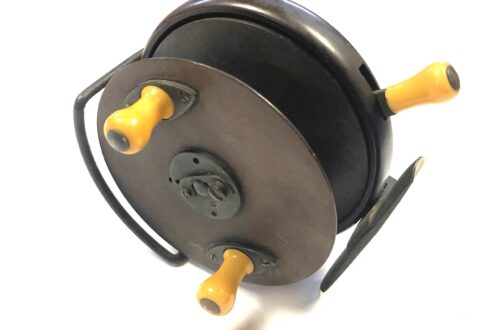

For over 150 years, the House of Hardy has been the gold standard for fly fishing excellence. While many anglers immediately think of the delicate clicks of a Hardy Perfect on a chalk stream, the brand’s foray into the salt produced one of the most robust and innovative reels of the 20th century: the Hardy Ocean Prince.
In this comprehensive guide, we explore why the Ocean Prince remains a coveted piece of equipment for both serious saltwater anglers and vintage tackle collectors.
Part 1: The Evolution of Saltwater Fly Fishing
In the mid-1980s, fly fishing was undergoing a transformation. Anglers were pushing boundaries, taking fly rods into the harsh, corrosive environments of the Caribbean and the Florida Keys. Hardy responded to this demand by blending their traditional craftsmanship with modern mechanical solutions.
Introduced in 1984, the Hardy Ocean Prince was designed to be more than just a “large” fly reel. It was a purpose-built saltwater machine. Unlike the click-pawl reels common at the time, the Ocean Prince featured a sophisticated disc drag system and a distinctive anti-reverse mechanism that set it apart from its contemporaries.
Key Heritage Features:
- Built in Alnwick, England: Hand-assembled by master craftsmen.
- Heavy-Duty Anodization: A deep, glossy black finish designed to withstand the corrosive effects of salt spray.
- Simplicity and Strength: Fewer moving parts meant less chance of failure in the heat of a “silver king” battle.
Part 2: Engineering Excellence — The Anti-Reverse Advantage
The defining characteristic of the Hardy Ocean Prince series is its Anti-Reverse (A/R) design. For those used to “knuckle-busters” (reels where the handle spins wildly as a fish peels off line), the Ocean Prince was a revelation.
The Mechanics of Control: How the Ocean Prince A/R System Works
To understand the Hardy Ocean Prince, you have to understand the departure from “Direct Drive” engineering. In a standard fly reel, the handle is fixed to the spool; if the spool spins at 50 mph because a Bonefish is tailing it, the handle spins at 50 mph.
The Ocean Prince utilizes a decoupled drivetrain. Here is the technical breakdown of that wizardry:
1. The One-Way Clutch Principle
Inside the housing of the Ocean Prince is a sophisticated one-way bearing (or “clutch”) system. When you turn the handle forward (clockwise), the mechanism engages the spool directly to retrieve line. However, the moment tension is pulled off the spool by a fish, the drive gear “disconnects” from the handle assembly.
2. The Stationary Handle (Safety First)
Because of this decoupling, the handle remains perfectly still while the spool screams in the opposite direction.
- Why it matters: In the 1980s, saltwater fly fishing was often a “bloody” sport. Catching a spinning handle on a high-speed run could result in bruised knuckles or even broken fingers. The Ocean Prince eliminated this “knuckle-buster” risk entirely.
3. Independent Drag Application
In a direct-drive reel, you can “palm” the rim of the spool to add drag. In an anti-reverse reel like the Ocean Prince, the drag is entirely internal and mechanical.
- Constant Pressure: Since the handle isn’t moving, the angler can keep a firm grip on the reel handle while the fish is running.
- Instant Recovery: The moment the fish stops or turns back toward the boat, you are already “in gear.” There is no fumbling to find a spinning handle; you simply start winding.
4. The “Slip-Clutch” Drag Stack
The Ocean Prince uses a sandwich of high-grade friction discs. When you tighten the drag knob on the back of the frame, you are increasing the compression on these discs. The spool is essentially “slipping” against this preset friction.
- Technical Note: Because the handle is stationary, the drag force remains 100% consistent. On direct-drive reels, an angler might inadvertently put pressure on the handle, causing a spike in tension that snaps a light tippet. The Ocean Prince removes that human error from the equation.
How it Works
In an anti-reverse reel, the handle remains stationary while the spool rotates under the pressure of a running fish. This allows the angler to keep their hand on the handle at all times, ready to regain line the moment the fish slows down, without the risk of the handle striking their fingers.
The Disc Drag System
The Ocean Prince utilized a powerful, adjustable disc drag. This provided a smooth, consistent startup inertia—crucial when using light tippets for spooky Bonefish or heavy pressure on a charging Tarpon. The drag adjustment is located on the backplate, allowing for “on-the-fly” micro-adjustments during a fight.
Part 3: The Lineup — Ocean Prince 1 vs. Ocean Prince 2
Hardy produced two primary sizes in this series to cover a wide range of saltwater and heavy freshwater applications (such as Salmon or Steelhead).
Design Nuances
Both models feature a Quick-Release (QR) spool, a feature pioneered by Hardy that allows for rapid line changes on the water. The reels also sport a ventilated frame and spool to aid in drying the backing and reducing overall weight without sacrificing structural integrity.
Part 4: The Collector’s Perspective
Today, the Hardy Ocean Prince is a “cult classic.” While it was eventually succeeded by the Sovereign and later the Zane series, the Ocean Prince holds a special place in history as the bridge between the old world and the new.
What to Look For When Buying
If you are searching the secondary market for a vintage Ocean Prince, pay close attention to these three factors:
- The Drag Nut: Ensure the drag adjustment turns smoothly. If it feels “crunchy,” the internal seals may have been compromised by dried salt.
- The Handle Play: Because it is an anti-reverse reel, there should be no backward movement in the handle itself, but the spool should spin freely against the drag.
- The Finish: While “boat rash” is common, heavy pitting in the aluminum can indicate the reel wasn’t rinsed properly after saltwater use.
Maintenance Tips
To keep an Ocean Prince in peak condition:
- Freshwater Rinse: Always rinse thoroughly in lukewarm freshwater after every saltwater outing.
- Minimal Lubrication: Use a drop of high-quality reel oil on the spindle and a tiny amount of marine-grade grease on the gear teeth. Avoid over-oiling the drag discs.
- Store with Drag Off: Always back off the drag tension when the reel is not in use to prevent the discs from compressing or “setting.”
The Verdict: Is the Ocean Prince Still Relevant?
Absolutely. While modern reels are lighter and feature carbon-fiber drags, the Hardy Ocean Prince offers a tactile soul that modern CNC-machined reels often lack. It is a testament to British engineering—a reel that feels substantial in the hand and sings with a refined growl when a big fish takes a run.
Whether you are a collector looking for a piece of Alnwick history or an angler who appreciates the safety of an anti-reverse system, the Ocean Prince remains a prince among reels.