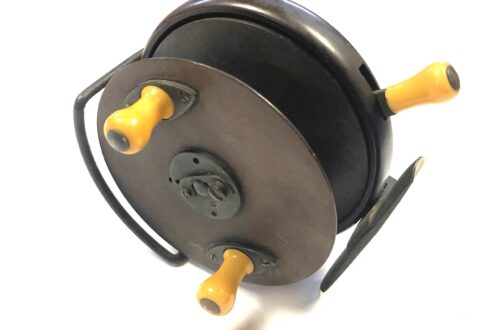

The Hardy Perfect: A Guide to Dating the King of Reels
For over 130 years, the Hardy Perfect has been the undisputed “King of Reels.” First patented in 1889 by Forster Hardy, it was the first reel to successfully integrate a ball-bearing race, a frame-in-spool design, and a lyrical, adjustable click-check.
For the collector, a vintage Perfect is more than a tool; it is a mechanical diary of the Hardy Brothers’ craftsmanship in Alnwick, England. This guide provides the technical roadmap to identifying and dating these legendary reels.
1. The Era Timeline: Evolution of Construction
The Perfect has survived two World Wars and the transition from brass to aerospace-grade aluminum. To date a reel, you must first identify its construction era.
| Era | Primary Materials | Key Identifiers |
| Brass Era (1891–1896) | All Brass / Gunmetal | Extremely heavy; “Open Race” ball bearings; “Rod-in-Hand” logo. |
| Transition Era (1897–1905) | Brass Face / Alloy Spool | Aluminum spools introduced; “Contracted” trout models appear. |
| The Golden Era (1906–1939) | Aluminum Alloy | “Leaded” finish; Ribbed brass feet; Agate line guards popular. |
| Post-War Era (1945–1966) | Aluminum Alloy | “Sun-tan” or Grey Enamel finish; Smooth alloy feet; Mark II checks. |
| Modern Revival (1970–Present) | Bar-stock Aluminum | Anodized finishes; “Ivorine” handles; Re-introduction of the 1912 check. |
2. The Heart of the Reel: Check Mechanisms
The “check” is the internal drag system. It is the most reliable way to date a Perfect, as the design changed significantly during patent renewals.
The 1891 Check (The Original)
The earliest models featured a simple “tongue” and wheel. These are often “frameless,” with the ball bearings visible around the central spindle.
The 1896 Check (The Rarity)
Identified by its “flat” spring and a small brass block that holds the pawl. These are highly sought after by collectors and usually found on “Brass Faced” reels.
The 1912 Check (The Holy Grail)
Considered the most beautiful and effective mechanical design. It features a heavy-duty, horseshoe-shaped spring and a unique compensating regulator. It provides the loudest and most iconic “Hardy Growl.”
The Duplicated Mark II (1917–1960s)
The most common vintage check. It features two sets of springs and pawls, allowing the angler to have a “spare” ready in case of failure. This was the standard for the majority of the 20th century.
3. Identification Charts: Logos, Feet, and Handles
Use these charts to narrow down the specific decade of your reel’s manufacture.
Logo Evolution Chart
| Logo Style | Estimated Dates | Description |
| Rod-in-Hand | 1891 – 1905 | A small arm holding a rod; usually stamped on the face plate. |
| Straight Line | 1905 – 1920 | “Hardy’s Pat. Perfect Reel” written in a straight line across the center. |
| Circular Writing | 1920 – 1950 | Writing follows the curve of the reel’s edge; “Made by Hardy Bros Ltd.” |
| Oval / Modern | 1950 – Present | A cleaner, oval-shaped logo or simple block lettering. |
Reel Foot & Handle Material Chart
| Component | Material / Style | Era |
| Foot | Long Smooth Brass | 1891 – 1910 |
| Foot | Ribbed Brass | 1910 – 1950s |
| Foot | Smooth Alloy (Grey) | 1950s – 1966 |
| Handle | Ivory / Ivorine | Early Brass & Modern Revivals |
| Handle | Ebonite (Black) | 1920s – 1940s |
| Handle | Plastic / Composite | Post-1950s |
4. Agate Line Guards: Materials and “Eyes”
The agate line guard was introduced in 1911 to prevent the friction of silk lines from “grooving” the aluminum frame.
- Red Agate: The most iconic and valuable. These semi-precious stones were sourced from Germany and Scotland. A vibrant, uncracked red agate can increase a reel’s value by 30%.
- Milky / White Agate: Common in the 1920s and 30s. They provide a classic, understated look.
- Smoke / Blue Agate: Rarer variations often found on high-end salmon models.
- Guard Frames: Early guards were made of Nickel Silver, while later post-war models often used Stainless Steel.
5. The Master Makers: Initials Chart
Before 1966, a single craftsman at the Alnwick factory was responsible for the entire assembly of a reel. They stamped their initials inside the frame as a signature of quality.
| Initials | Maker Name | Active Years | Specialization |
| R.B. | Robert Borthwick | 1890 – 1920 | Built the very first Brass-Faced Perfects. |
| J.W. | John “Jackie” Waugh | 1893 – 1916 | Master of “Contracted” Trout models. |
| D | William Dingley | 1891 – 1911 | Later started his own famous firm. |
| J.S. | Jimmy Smith | 1908 – 1960 | The most prolific maker; built ~40% of vintage Perfects. |
| T.A.G. | Thomas Armstrong | 1928 – 1978 | Expert in post-war alloy transitions. |
| A.H.W. | Arthur Wall | 1901 – 1939 | Known for massive Salmon and Sea reels. |
6. Collector’s Summary: How to Spot a “Gem”
When evaluating a Hardy Perfect for purchase or sale, the “Condition Grade” is determined by:
- The Finish: Does it still have its original dark “Leaded” coating? (Often called “Gunmetal”).
- The Agate: Is the stone free of hairline cracks?
- The Tightness: Is there side-to-side “play” in the spool? A “tight” reel with no spindle wear is worth significantly more.
- Provenance: Do the initials match a famous maker like Jimmy Smith or Robert Borthwick?
By combining the data from the check mechanism, the logo style, and the maker’s initials, you can date your Hardy Perfect to within a 2-3 year window—solidifying its place as a cornerstone of your collection.
The “Secret Code”: Decoding Hardy Perfect Patent Numbers
On many vintage Hardy Perfects, you will find a series of numbers stamped into the frame or faceplate. These aren’t serial numbers; they are Patent Numbers. Because Hardy was an engineering-first company, they updated their patents frequently to protect their innovations.
Knowing these numbers allows you to pinpoint the “earliest possible” date for your reel.
| Patent Number | Year Issued | Significant Feature |
| No. 2424 | 1891 | The original “Ball Bearing” patent. Found on early Brass-Faced reels. |
| No. 9261 | 1904 | The “Contracted” Perfect patent (making the reel narrower and lighter). |
| No. 2261 | 1911 | Introduction of the Agate Line Guard frame design. |
| No. 24245 | 1912 | The legendary 1912 Check mechanism with the horseshoe spring. |
| No. 145904 | 1917 | The “Duplicated Mark II” check (the dual-pawl system). |
| No. 658472 | 1950s | Post-war improvements to the spool-retaining screw and alloy mix. |